How to Reach Out on LinkedIn Without Sounding Spammy
 Gerald Ebenezer
Learn how to reach out on LinkedIn without sounding spammy. A simple, proven approach to networking that actually gets replies.
If you've ever wondered how to reach out to people on LinkedIn and actually get a response, you're not alone. In a world where everyone's inbox is crowded, the difference between being ignored and being noticed usually comes down to a few simple things: relevance, personalization, and timing.
In this post, you'll learn how to make your outreach more effective, especially if you're a student, early-career professional, or someone trying to build genuine connections in your field. The advice here is based on a practical conversation about networking in today's internet-driven world, where a thoughtful message can open doors — while a generic one usually gets skipped.
Before you dive in, here's a short video that walks through the same idea — using LinkedIn well to open doors in your career. This is an excerpt from a recorded session on "Personal Branding for Fresh Graduates" with Theo Rowley and several fresh graduates in attendance.
Start Close to Home First
One of the biggest mistakes people make is trying to network too widely, too quickly. If you're based in Malaysia, for example, it often makes more sense to start with people in your immediate country or region before reaching out to someone across the world.
Why? Because proximity creates familiarity. People are more likely to respond when there's some shared context — the same university, the same region, the same professional environment, or even just a better understanding of local opportunities. That doesn't mean you can never reach out internationally. It just means your response rate is usually better when you begin with people who are closer to your world.
This is especially important if you're trying to build momentum. A few replies from nearby professionals can help you refine your approach before you start reaching out more broadly.
Think in Tiers, Not Just in Contacts
A helpful way to approach outreach is to think in tiers of connection:
- Tier one: People in your immediate country or region
- Tier two: People in neighboring markets or nearby professional hubs
- Tier three: People in distant countries where you have less shared context
The farther away someone is from your context, the more likely your message needs to work harder. That's not a reason not to reach out — it's a reminder to be strategic.
Networking Etiquette for Malaysia and the Region
Good networking advice still needs to fit the culture you're in. A few things worth keeping in mind if you're reaching out to professionals in Malaysia or the wider APAC region:
- Respect for seniority matters. Address people politely (Mr./Ms./Dr., or their professional title) until they invite you to be more casual.
- It's fine to warm up over the conversation, but don't assume first-name familiarity from message one. WhatsApp often follows LinkedIn.
- In this region, it's common for a good LinkedIn conversation to move to WhatsApp for scheduling a call or staying in touch. Wait for them to suggest it, or ask politely — don't assume.
- Modesty goes further than confidence. A message that comes across as humble and curious tends to land better here than one that sounds like a pitch.
- Let your questions show your ambition, rather than stating it outright. Referrals are personal. In many Malaysian and regional workplaces, recommending someone reflects on the person making the introduction.
- Don't ask for a referral too early — earn it through a genuine conversation first.
None of this changes the core advice in this post. It's the same principles — relevance, personalization, timing — just applied with a bit more cultural awareness.
Linkedin Works Best When Your Profile Is Ready
Before you message anyone, make sure your LinkedIn profile is doing its job. If someone clicks your name after reading your message, your profile should immediately answer three questions: who you are, what you're interested in, and why you're worth talking to.
A strong LinkedIn profile doesn't need to be perfect. In fact, trying to make it perfect can slow you down. What matters more is that it's clear, honest, and active enough to show you're serious. A well-written headline, a decent summary, and a few details about your studies, interests, or experience are already a major step up from an empty profile.
Theo Rowley in the transcript makes an important point here: don't be afraid of oversharing too much — the bigger risk is undersharing. People need something to respond to. If your profile is too sparse, even a good message may fall flat because there's no context.
What Your Profile Should Communicate
At a minimum, your LinkedIn profile should make these things obvious:
- What you're studying or working on
- What field you want to enter
- What kind of conversations you're open to
- What makes you approachable and credible
You're not trying to impress everyone. You're trying to make it easy for the right people to understand you quickly.
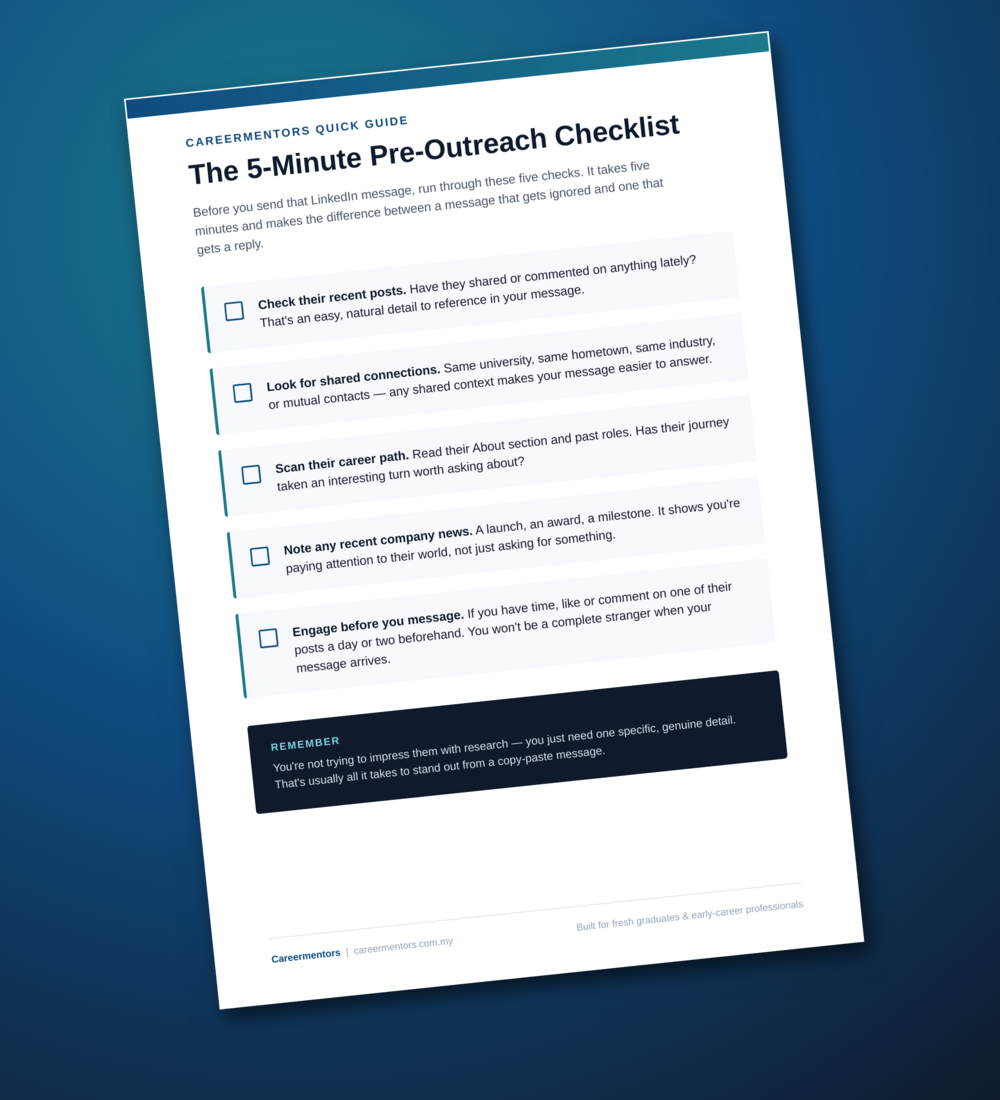
Do Your Homework First (In 5 Minutes or Less)
Before you write a single word, spend a few minutes learning about the person. You don't need a deep dive — just enough to make your message feel like it's for them, not for anyone.
Here's a quick checklist:
- Their recent posts — Have they shared or commented on anything lately? That's an easy, natural thing to reference.
- Shared connections — Do you have mutual contacts, the same university, or the same hometown?
- Their career path — Look at their "About" section and past roles. Has their journey taken an interesting turn?
- Recent company news — A product launch, an award, a milestone. It shows you're paying attention to their world, not just asking for something.
You're not trying to impress them with research. You're just making sure your message has one specific, genuine detail in it — that's usually all it takes to stand out from a copy-paste message.
A small step before messaging If you have time, like or leave a thoughtful comment on one of their posts a day or two before you message them. It's a small thing, but it means you're not a complete stranger when your message lands in their inbox.
The Best Outreach Messages Are Short, Specific, and Personal
If you want a reply, your message should feel like it was written for one person — not copied and pasted to fifty people.
A good outreach message usually has three parts:
- Who you are
- Why you are reaching out
- What you want to learn
That's it. You do not need a long introduction, your full life story, or a list of achievements. You just need enough context for the person to understand why your message is relevant.
For example, instead of saying, "Hi, I'd love to connect," you could say something like:
Hi Mary, I'm currently studying in Malaysia and interested in building a career in investment banking. I came across your profile and would love to learn more about your experience at Standard Chartered and the challenges you have faced in your role.
That message works because it is specific, respectful, and easy to answer. It doesn't demand too much, and it gives the recipient a clear reason to respond.
The transcript also suggests that if you can find an email address, a crisp, personalized email can be even better than a LinkedIn note. That's not because email is inherently superior — it's because a well-targeted message sent through the right channel often feels more thoughtful than a generic connection request.
What Makes a Message Feel Spammy
A message starts to feel spammy when it has too many of these qualities:
- It's obviously copy-pasted
- It doesn't mention anything specific about the recipient
- It asks for too much too soon
- It sounds overly formal or robotic
- It focuses on what you want instead of what the other person might care about
The fix is simple: make the message feel human. Mention something specific about their role, company, career path, or location. Show that you did a little research. That alone can raise your chances of getting noticed.
Ask for a Conversation, Not a Favour
One of the smartest shifts you can make in outreach is changing the ask. Instead of immediately asking for a job or internship, ask to learn from the person's experience.
That matters because most professionals are more open to a conversation than to a direct request. If you ask about their challenges, priorities, objectives, or career path, you're signaling that you value their perspective — not just their contacts.
This approach also lowers the pressure on both sides. The other person doesn't have to decide whether to "give you something." They just have to decide whether they're open to a short conversation.
The transcript puts this very clearly: the best outcome is not just a reply. It might be a coffee chat, a helpful conversation, mentoring, support, or even a future opportunity. But those doors usually open after the first conversation, not before it.
A Better Outreach Question
Instead of asking:
- Can you help me get a job?
- Are there openings in your company?
- Can you refer me?
Try asking:
- What challenges are you currently seeing in your role?
- What do you think helped you get to where you are?
- What would you recommend someone like me focus on if I want to enter this field?
These questions are easier to answer, and they create space for a real conversation.
Don't Be Afraid to Make the First Move
A big theme in the conversation is courage. The speaker's message is simple: don't wait forever for the perfect moment. Reach out.
That doesn't mean being pushy. It means being willing to take the first step, even if there's a chance you won't get a response. In networking, silence is common — but so is opportunity. The worst-case scenario is usually no reply. The best-case scenario could be a conversation that changes your perspective, expands your network, or leads to an opportunity you wouldn't have found otherwise.
This is where a lot of people get stuck. They assume they need a perfect profile, a perfect message, or a perfect relationship before they can contact someone. In reality, a simple, respectful, well-written message is often enough to start.
A Practical Mindset Shift
If you're nervous about reaching out, remember this:
- You are not bothering people by being thoughtful
- Most people appreciate concise, respectful messages
- Reaching out is a skill, and skills improve with practice
- One good conversation is worth more than ten silent attempts
The more you practice, the better you'll get at reading tone, choosing the right words, and understanding which messages earn responses.
A Quick Reality Check
Before you start reaching out, it helps to set realistic expectations:
- Most messages won't get a reply. That's normal, not a reflection of you. A reply rate of 20–30% is a solid outcome for cold outreach.
- Most conversations won't lead directly to a job. And that's fine — the goal is to build relationships and learn, not to land an offer from every chat.
- Consistency beats intensity. A few thoughtful messages a week, kept up over months, will build a stronger network than a single burst of outreach.
Networking is a long game. Every conversation adds up, even the ones that don't lead anywhere obvious right away.
A Simple LinkedIn Outreach Template You Can Use
If you want something practical, here's a basic template you can adapt:
Hi [Name],
I'm [your name], currently [studying/working] in [location]. I am interested in building a career in [field] and came across your profile while researching professionals in this space.
I would love to learn more about your experience at [company] and hear any advice you'd have for someone trying to grow in this area. If you're open to it, I'd really appreciate the chance to connect.
Thank you for your time.
This works because it is brief, specific, and respectful. It doesn't overpromise. It doesn't ask for too much. And it gives the recipient an easy way to say yes.
If you're reaching out via email, the same logic applies. Keep the subject line simple, the body concise, and the ask clear.
How to Follow Up Without Sounding Pushy
You sent a good message. No reply. Now what?
Silence doesn't mean no. People get busy, messages get buried, and a follow-up is completely normal — as long as you do it right.
When to follow up Wait about a week. Not two days (too soon), not a month (they've forgotten the context).
What to say Keep it short. Don't repeat your whole pitch — just gently resurface it.
Hi [Name], just following up on my message from last week. I understand you are probably busy, so no pressure at all. If you do get a moment, I would still love to hear your thoughts on [specific thing you asked about]. Thanks again!
The one-follow-up rule - Send it once. If there's still no reply after that, let it go and move on to the next person. Following up more than once starts to feel like pressure, not interest — and it can work against you if you ever want to reach out to that person again down the line.
What to Do When They Say Yes
Getting a "sure, happy to chat" reply is a small win — but it's also where a lot of people freeze. Here's how to make the most of it.
Before the call
- Confirm a time that works for both of you, and keep it short (15–20 minutes is usually enough)
- Write down 3–4 questions in advance so you're not scrambling mid-conversation
- Look them up again right before the call — a recent post or project is easy small talk to open with
During the conversation Treat it like a conversation, not an interview you're being graded on. A few reliable questions to ask:
- "What does a typical week look like for you?"
- "What's one thing you wish you'd known when you were starting out?"
- "What skills do you think matter most in this field right now?"
- "Is there anyone else you think I should talk to?"
Let them talk more than you do. Your job is mostly to listen and ask good follow-up questions.
Closing well Near the end, say thank you and ask if it's okay to stay in touch. If the conversation went well, this is also a natural moment to ask if they know anyone else worth talking to — most people are happy to make an introduction once they've already spoken with you.
After the call Send a short thank-you message within a day or two. This is the step most people skip, and it's often what makes you memorable.
Hi [Name], thank you again for taking the time to chat today. I really appreciated your advice on [specific thing they said]. I will keep you posted on how things go — and thanks again for your time!
That's it. No need to overthink it. A short, specific thank-you goes a long way.
Common Mistakes People Make After the First Reply
Getting a reply is the hard part — but plenty of people lose the connection right after. Watch out for these:
- Asking for a job too soon. Even after a great conversation, jumping straight to "can you refer me?" can feel transactional. Let the relationship develop over a conversation or two first.
- Going quiet after they help you. If someone gives advice, makes an introduction, or spends time with you, and you never follow up or tell them how it went — that's the fastest way to be forgotten.
- Only reaching out when you need something. If the only time someone hears from you is when you want a favour, that's noticeable. A quick, genuine check-in every few months keeps the relationship alive.
- Treating one conversation as the finish line. A single chat is a start, not a result. The real value usually comes from staying in the person's orbit over time.
Turning One Conversation Into a Network
A single good conversation can open up an entire network — but only if you nurture it.
Ask for the next connection, gently If a conversation goes well, it's natural to ask: "Is there anyone else you think I should speak with?". Most people are glad to introduce you once they've spoken with you directly — it's a much easier ask than requesting a referral straight away.
Stay in touch without being a pest. You don't need to message someone every week. A light touchpoint every couple of months is enough — congratulating them on a promotion, sharing something relevant to a topic you discussed, or a quick update on how their advice helped you.
Keep track of who you've spoken to. As your network grows, it gets hard to remember who you talked to and what was discussed. Set up a simple spreadsheet with columns for: Name, Company, Date Contacted, Status, Notes.
Even a basic version of this will save you from awkwardly re-asking someone the same question twice.
Frequently Asked Questions
How many people should I reach out to on LinkedIn? There's no perfect number, but consistency matters more than volume. A few thoughtful messages each week will usually outperform a big batch of generic ones.
Should I contact people outside my country? Yes, but start with local or regional contacts first if you're new to networking. People closer to your context are often easier to reach and more likely to respond.
Is it better to use LinkedIn or email? Use the channel that gives you the best chance of being seen and taken seriously. LinkedIn is convenient, but email can be more effective if you have a professional, personalized address.
What should I say if they reply? Keep the conversation natural. Ask about their path, their current role, or what they'd recommend for someone entering the field. Don't rush into asking for a job.
What if they don't respond? That's normal. Don't take it personally. Follow up once after a reasonable amount of time, then move on and continue building your network elsewhere.
Don't Just Read This — Use It
You've just read what it takes to reach out well. Now make it easy to actually do it.
Grab the free 5-Minute Pre-Outreach Checklist — the five quick checks from this article, condensed into a single page you can run through right before you hit send.
Get the Free Checklist → [Free Pre-outreach Checklist]
And if it helps you land a conversation, tag me on LinkedIn and let me know how it went.
Categories: : Linkedin Outreach